
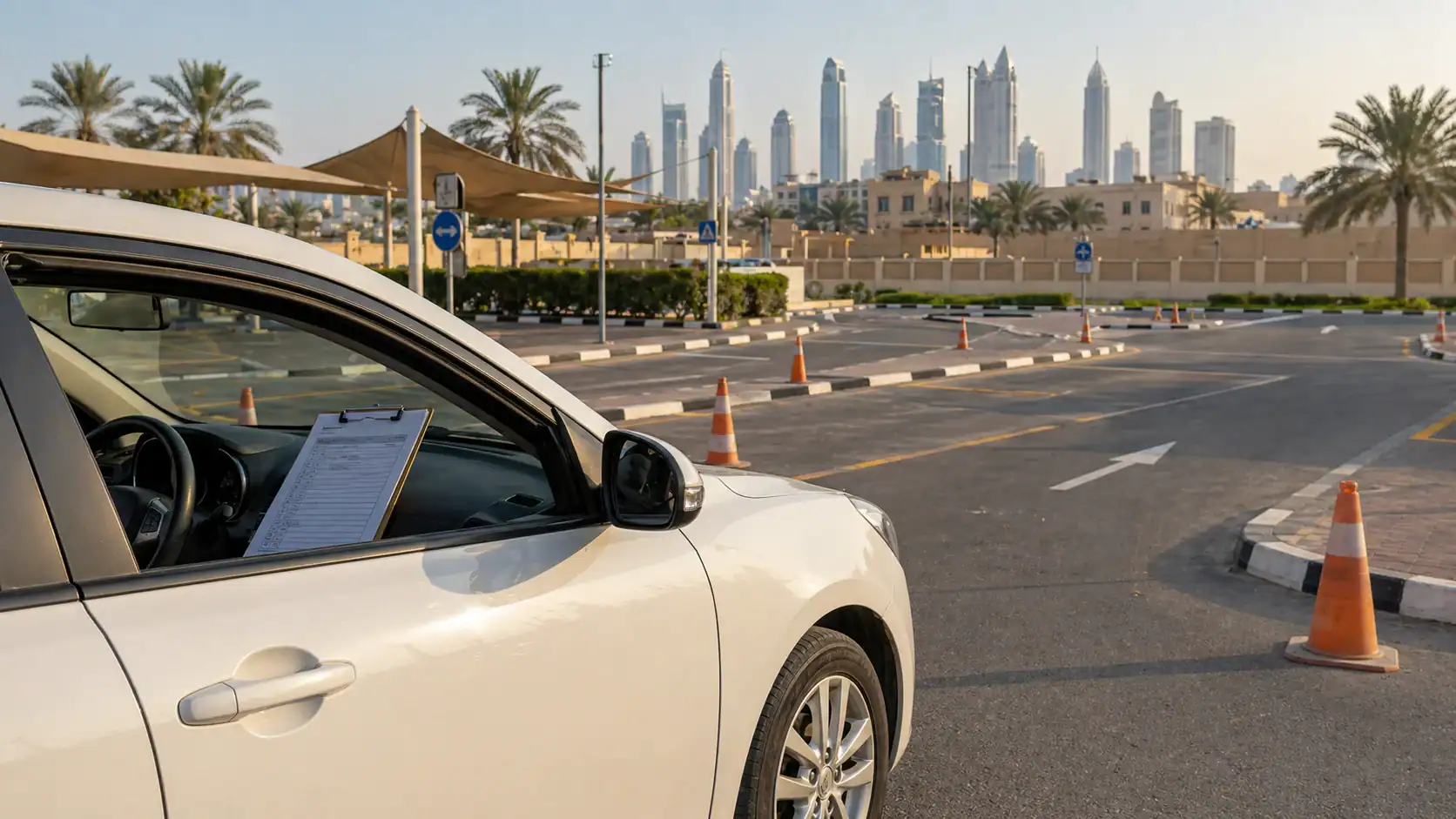
If you are searching for RTA driving test practice, you are past theory. You do not need more road-sign revision. You need to stop giving the examiner reasons to touch the brake, correct the steering, or write one major mistake on your result.
The Dubai road test is not looking for a perfect driver. It is looking for a safe driver who can read the road, make calm decisions, and show every safety check clearly.
That last word matters.
Recommended Reading
Want to accelerate your career? Get Kim Kiyingi’s From Campus to Career – the step-by-step guide to landing internships and building your professional path. Browse all books →
Clearly.
Many learners do the right check but hide it inside tiny eye movement. The examiner cannot score what they cannot see.
Quick Answer
The best RTA driving test practice in Dubai is not random driving around your school area. It is repeated practice of the behaviours examiners watch closely: mirror checks, blind spot checks, lane discipline, speed control, roundabout decisions, stop-line discipline, parking control, and safe gap judgement.
The official RTA driving licence service page confirms that customers must pass the required tests before receiving the licence. The RTA Light Motor Vehicle Handbook gives the safety rules behind those tests. Your job is to turn those rules into visible driving habits.
Where This Page Fits In The RTA Cluster
If you are still preparing for the theory stage, start with our RTA practice theory test guide. If you want timed questions first, use the RTA theory test mock exam.
This page is different. It is for the practical road test stage, when the issue is not what you know. It is what your hands, eyes, feet, and decisions show under pressure.
The 7 Skills To Practise Before The Road Test
1. Mirror Checks That Are Visible
Do not flick your eyes quickly and assume the examiner noticed. Check centre mirror, side mirror, signal when needed, then check the blind spot before moving. Make the movement natural but visible.
This is not theatre. It is evidence. You are showing the examiner that you know what is around the car before you change the car’s position.
2. Lane Discipline
Stay centred in the lane. Do not drift towards parked cars, kerbs, lane markers, or the vehicle beside you. In Dubai, road lanes can feel wide until traffic appears beside you. Practise holding your lane without staring at the line.
Before a turn, choose the correct lane early. Late lane changes tell the examiner you saw the road too late.
3. Speed Control
Driving too fast is unsafe. Driving too slowly without reason can also show poor confidence. The goal is steady speed that fits the road, signs, traffic, weather, and instruction.
On test day, do not let fear turn you into a rolling obstruction. A safe driver is not a frozen driver.
4. Roundabout Decisions
Roundabouts expose hesitation fast. Practise lane choice, entry timing, signalling, and exit control. If you enter too late, you hesitate. If you enter too early, you force others to react.
The examiner is watching your judgement, not only your steering.
5. Stop-Line Discipline
Stop before the line, not on it, not after it, and not with the front of the car creeping forward. A rolling stop can look small to you and serious to the examiner.
Practise full stops until they feel normal. The test is not the place to discover your foot is impatient.
6. Safe Gap Judgement
When you join a road, leave a safe gap. When you change lanes, do not cut into a space that makes another driver brake. When you follow traffic, leave enough distance to react.
The RTA handbook places strong focus on risk, distance, and road-user awareness. That is the frame the road test sits inside.
7. Calm Recovery
A small mistake does not always mean failure. Panicking after a small mistake can create the major one. If you miss an instruction, stay calm and follow the next safe instruction. If you are unsure, ask for clarification when it is safe.
The test is not only checking your driving. It is checking whether pressure changes your driving.
Common Reasons Learners Fail
A 2026 Gulf News report on Dubai road-test failures listed common serious errors such as entering a no-entry zone, stopping inside a yellow box junction, failing to give way at a roundabout, poor lane discipline, missing mirror or blind spot checks, and weak vehicle control. The report also quoted a Dubai driving expert who said the problem often goes beyond basic skill and sits in the learner’s mental block under test pressure.
That matches what many learners describe after failing: “I know how to drive, but I changed under exam pressure.”
So your practice should include pressure. Ask your instructor to run mock-test routes with fewer hints. Ask them to stay quiet unless safety requires intervention. You need to feel the silence before test day.
Property Finder’s RTA driving test guide also frames Dubai’s driving process as theory, yard or parking assessment, and the final road test. Emirates Driving Institute’s light motor vehicle training journey PDF tells learners to bring the RTA learner’s permit, EDI student card, Emirates ID, and RTA driving handbook for training classes, lectures, and driving tests. That is the practical side of readiness: skill, documents, and calm timing all have to arrive together.
RTA Road Test Practice Checklist
| Skill | What to practise | What the examiner should see |
|---|---|---|
| Observation | Mirrors and blind spot checks | Visible head and eye movement before action |
| Lane control | Holding centre position | No drifting, no late correction |
| Speed | Driving to road conditions | No rushing, no needless crawling |
| Turns | Lane choice and signalling | Early preparation and smooth steering |
| Roundabouts | Entry, lane choice, exit | Safe gap and clear signal timing |
| Stops | Stop signs and traffic lights | Full stop before the line |
| Parking | Reference points and control | Slow, planned movement |
What To Do 48 Hours Before The Test
Do one mock road test with your instructor. Ask them to mark only the faults that would worry an examiner. Then build your final practice around those faults, not around random driving.
Do not add a new trick the night before the test. Do not change mirror settings, seating position, shoes, or driving rhythm unless your instructor tells you there is a real safety issue.
The day before, review the RTA handbook sections on signs, lane use, distance, speed, and vulnerable road users. Also check the official RTA Dubai Drive app for digital licence and learner services available through RTA channels.
Test-Day Checklist
- Sleep properly. Tired learners make late decisions.
- Arrive early enough to avoid rushing.
- Carry Emirates ID and any test booking details your school requires.
- Adjust seat, mirrors, steering position, and seat belt before moving.
- Listen fully before acting on an instruction.
- Show checks clearly before moving, turning, braking, or changing lanes.
- Drive the road in front of you, not the mistake you fear.
If You Fail The Road Test
Do not turn the result into a character judgement. Turn it into a fault map.
The official RTA driving licence service page explains that if a customer fails the road test, they take training hours without repeating the theory part, based on previous experience. Use that time properly. Ask your instructor to recreate the exact weakness, whether it was lane choice, roundabout timing, speed control, observation, or hesitation.
Do not practise everything again equally. Practise the thing that failed you.
Final Word
RTA driving test practice is not about looking confident. It is about giving the examiner visible proof that you are safe.
Make the check visible. Make the decision early. Make the movement smooth. The pass comes from habits the examiner does not need to question.